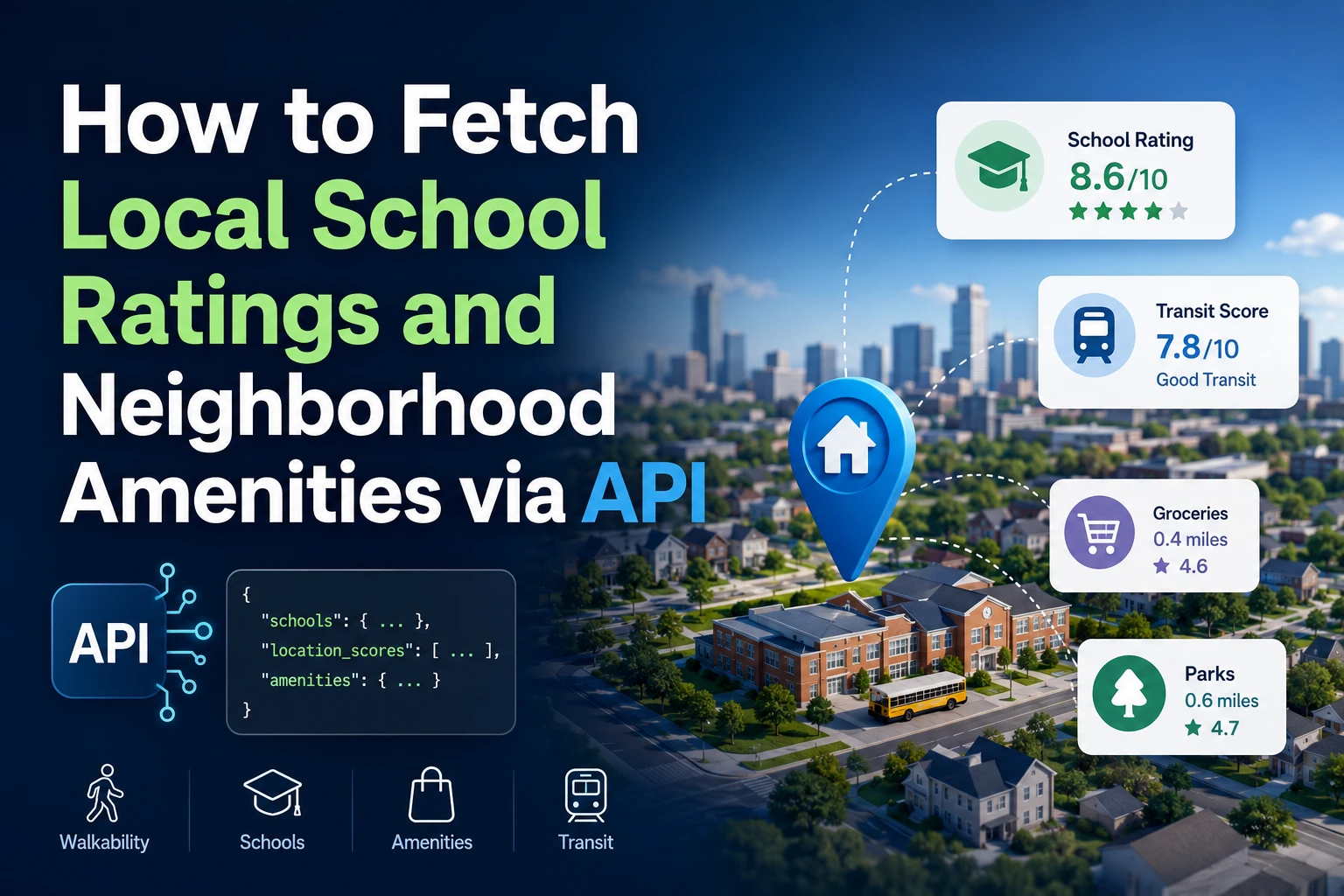
A property’s utility and market value are heavily influenced by its surroundings. School district performance, transit accessibility, and local amenities are often the highest-ranking factors home buyers and renters evaluate when looking for a home.
For developers building real estate platforms, listing portals, or programmatic valuation models, manually aggregating this data is a complex task. Unifying geographical data typically requires maintaining multiple fragile integrations—such as school directory feeds, local business review APIs, and regional transit datasets.
This guide demonstrates how to programmatically fetch verified school ratings, transit scores, and categorized local amenities using a single API call. By consolidating these variables into a unified JSON schema, you can enrich your property listings and build custom neighborhood dashboards with minimal overhead.
Ingestion Plan
We will use the SteadyAPI Neighborhood Amenities Endpoint to fetch and parse three key pillars of neighborhood quality:
- Location Scores: Quantify walkability and transit dependencies.
- Local Schools: Extract performance ratings, enrollment metrics, and catchment assignment statuses.
- Categorized Amenities: Query nearby businesses (groceries, dining, parks) within a specified mile radius.
Obtain Your API Key
To get started, generate your personal credentials.
- Create an account on the SteadyAPI Registration Page.
- Generate an access token via your account’s Personal Access Tokens Page.
1. Authentication
To authenticate your requests, pass your personal access token as a Bearer token in the Authorization header of every HTTP call, as outlined in the SteadyAPI Authentication Guide.
import os
import requests

# Fetch the API key from environment variables for security
API_KEY = os.getenv('STEADY_API_KEY', 'YOUR_AUTH_KEY')

headers = {
    'Authorization': f'Bearer {API_KEY}',
    'Content-Type': 'application/json'
}
2. Strategy 1: Programmatic Location Scoring (Walkability & Transit)
The first step in defining neighborhood quality is understanding its general lifestyle fit. How pedestrian-friendly is the immediate area?
The SteadyAPI Neighborhood Amenities Endpoint returns a location_scores array containing normalized indexes for transit types and walkability. This eliminates the need to cross-reference coordinates against external GIS datasets.
def get_location_scores(property_id):
    url = 'https://api.steadyapi.com/v1/real-estate/neighborhood-amenities'
    params = {
        'propertyId': property_id,
        'radius_in_miles': 3,  # Target a tight radius for immediate transit
        'category_limit': 1
    }

    response = requests.get(url, headers=headers, params=params)
    response.raise_for_status()
    data = response.json().get('body', {})

    scores = data.get('location_scores', [])
    print(f"--- Location Scores for Property {property_id} ---")
    for score in scores:
        label = score.get('label')
        value = score.get('value')  # Typically an index score out of 10
        summary_text = score.get('text')
        print(f"[{label}] Score: {value}/10 - {summary_text}")

get_location_scores('1874828523')
3. Strategy 2: Fetching and Filtering Local School Data
Your application needs to distinguish between elementary, middle, and high schools, identify whether they are public or private, and extract performance metrics.
The Neighborhood Amenities API yields a consolidated nested schools object containing overall summary statistics and a granular listing of nearby academic institutions.
def analyze_local_schools(property_id):
    url = 'https://api.steadyapi.com/v1/real-estate/neighborhood-amenities'
    params = {
        'propertyId': property_id,
    }

    response = requests.get(url, headers=headers, params=params)
    data = response.json().get('body', {})
    schools_data = data.get('schools', {})

    # High-level summary
    summary = schools_data.get('summary', {})
    print(f"Average School Rating: {summary.get('avg_rating')}/10")
    print(f"Total Nearby Schools: {summary.get('total')} ({summary.get('public')} Public, {summary.get('private')} Private)")

    # Detailed school breakdown
    print("\nDetailed School Directory:")
    for school in schools_data.get('list', [])[:3]:
        name = school.get('name')
        rating = school.get('rating')  # Performance rating
        assigned = "Assigned" if school.get('assigned') else "Alternative"
        levels = ", ".join(school.get('education_levels', []))
        ratio = school.get('student_teacher_ratio')
        distance = school.get('distance_in_miles')

        print(f"- {name} ({levels.upper()}) | Rating: {rating}/10 | {assigned}")
        print(f"  Distance: {distance} miles | Student-Teacher Ratio: {ratio}:1")

analyze_local_schools('1874828523')
Key Metrics to Track:
assigned: Indicates if the school is the primary designated public option for the property’s local attendance boundary.student_teacher_ratio: A smaller ratio typically correlates with higher classroom engagement, a major selling point for families.
4. Strategy 3: Mapping Local Amenities
Convenient access to local infrastructure heavily impacts tenant retention and property demand. By utilizing the categories parameter in the Neighborhood Amenities Endpoint, you can narrow down the returned entities to only the types relevant to your current user interface.
Supported filter tags include: LOCAL_ACTIVE_AND_OUTDOOR, LOCAL_GROCERIES, LOCAL_SHOPPING, LOCAL_ENTERTAINMENT, LOCAL_FOOD_AND_DRINK, LOCAL_CAFES, and LOCAL_PRESCHOOLS.
def fetch_local_conveniences(property_id):
    url = 'https://api.steadyapi.com/v1/real-estate/neighborhood-amenities'
    params = {
        'propertyId': property_id,
        'categories': 'LOCAL_GROCERIES,LOCAL_CAFES', # Filter down to essentials
        'radius_in_miles': 2,
        'category_limit': 3,
        'sort': 'DISTANCE'  # Nearest venues first
    }

    response = requests.get(url, headers=headers, params=params)
    data = response.json().get('body', {})
    amenities = data.get('amenities', {}).get('by_category', {})

    for category_key, items in amenities.items():
        print(f"\n--- Category: {category_key.upper()} ---")
        for item in items:
            name = item.get('name')
            rating = item.get('rating')
            reviews = item.get('reviews_count')
            address = item.get('address', {}).get('line_one')
            distance = item.get('address', {}).get('distance_from_property')

            rating_str = f"{rating}/5 ({reviews} reviews)" if rating > 0 else "No reviews yet"
            print(f"- {name} ({distance} miles away) | Address: {address}")
            print(f"  Rating: {rating_str}")

fetch_local_conveniences('1874828523')
5. Putting It All Together: Custom Neighborhood Scoring
To turn raw data into a unique user experience, you can programmatically combine these variables on your backend to calculate a custom "Neighborhood Score" tailored to specific buyer personas (e.g., Families vs. Commuters).
def calculate_neighborhood_score(property_id):
    url = 'https://api.steadyapi.com/v1/real-estate/neighborhood-amenities'
    params = {
        'propertyId': property_id,
        'categories': 'LOCAL_GROCERIES,LOCAL_CAFES',
        'radius_in_miles': 5
    }

    response = requests.get(url, headers=headers, params=params)
    data = response.json().get('body', {})

    # 1. School Quality (Weighted at 50%)
    school_avg = data.get('schools', {}).get('summary', {}).get('avg_rating', 5.0)

    # 2. Walkability Index (Weighted at 30%)
    scores = data.get('location_scores', [])
    walk_val = 5.0
    for score in scores:
        if score.get('label') == 'Walking':
            walk_val = score.get('value', 5.0)

    # 3. Amenity Density (Weighted at 20%)
    amenity_items = data.get('amenities', {}).get('all', [])
    amenity_count = len(amenity_items)
    # Normalize density score: 10+ amenities = maximum score of 10
    density_val = min(amenity_count, 10)

    # Final consolidated calculation
    composite_score = (school_avg * 0.5) + (walk_val * 0.3) + (density_val * 0.2)
    print(f"Prop ID {property_id} Neighborhood Quality Score: {composite_score:.2f} out of 10")

calculate_neighborhood_score('1874828523')
Final Thoughts
Unifying geographical metadata through single API endpoints streamlines your backend processes. SteadyAPI normalizes complex location, school, and merchant datasets into predictable JSON schemas, allowing your engineering team to focus on constructing rich user experiences rather than managing fragile scraping scripts.
To explore additional parameters, regional targeting details, and further property indicators, consult the full SteadyAPI Real Estate Section.