Real estate platforms, proptech applications, and mortgage-lending pipelines rely heavily on predictive property metrics to evaluate assets and model risk. Whether you are building an investment calculator, an automated valuation model (AVM), or a portfolio analytics tool, you need structured programmatic access to both historical property performance and future projections.
However, gathering this data manually presents massive structural bottlenecks. Municipal public databases are highly fragmented, and county clerk websites frequently restrict access or alter their HTML structures to block data mining.
This developer guide demonstrates how to build a programmatic valuation pipeline using SteadyAPI. Rather than maintaining complex scraping scripts, we will pull cleanly structured JSON containing historical valuations, multi-provider projections, and hyper-local neighborhood metrics directly from institutional databases.
Ingestion Plan
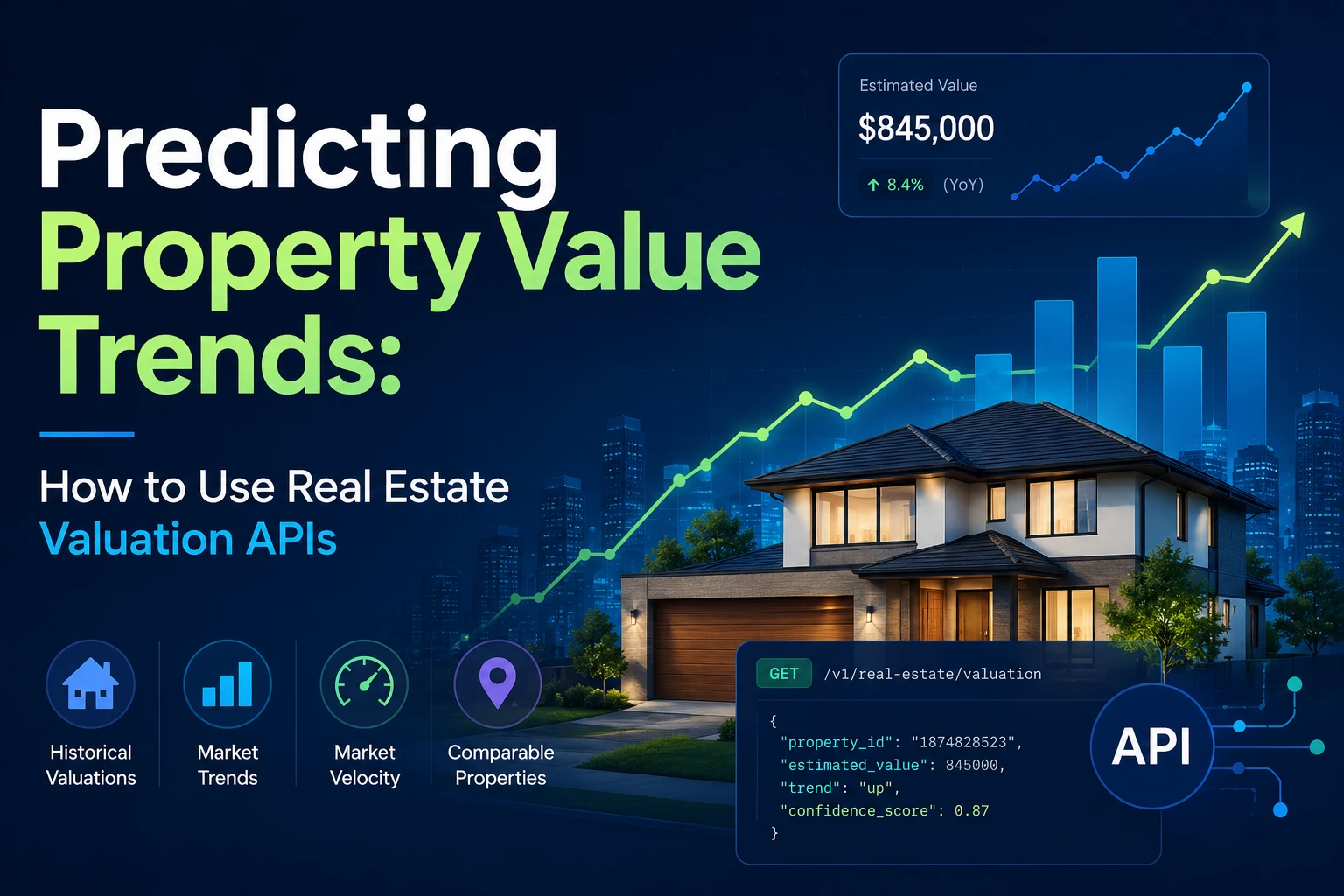
We will design a backend analytics pipeline that implements four key API strategies:
- Multi-Source Property Valuations: Retrieve historical and forecasted valuations for individual homes.
- Neighborhood Micro-Trends: Assess localized sales metrics like median list prices and median sold prices.
- Local Market Desirability: Extract hotness metrics and list-to-sold ratios to calculate market velocity.
- Hyper-Local Comparables (Comping): Benchmark properties against nearby assets with similar parameters.
Obtain Your API Key
To follow along with this guide, make sure to generate your personal API credentials:
- Register an account on the SteadyAPI Registration Page.
- Create an access token on the Personal Access Tokens Page.
1. Authentication
To authenticate your requests, pass your personal access token as a Bearer token in the Authorization header of every HTTP request, as detailed in the Authentication Guide.
import os
import requests

# Fetching the API key from environment variables for security
API_KEY = os.getenv('STEADY_API_KEY', 'YOUR_AUTH_KEY')

headers = {
    'Authorization': f'Bearer {API_KEY}',
    'Content-Type': 'application/json'
}
2. Strategy 1: Fetching Multi-Provider Property Value Estimates
When modeling property values, relying on a single data source introduces risk. Aggregating values from multiple institutional sources—such as CoreLogic, Quantarium, and Collateral Analytics—creates a highly balanced pricing baseline.
We will use the Property Estimates Endpoint to pull both historical valuations and future pricing projections.
def fetch_valuation_projections(property_id):
    url = 'https://api.steadyapi.com/v1/real-estate/property-estimates'
    params = {
        'propertyId': property_id,
        'historicalYearsMin': '2021-01-01',
        'historicalYearsMax': '2026-06-01',
        'forecastedMonthsMax': '2026-12-01'
    }

    response = requests.get(url, headers=headers, params=params)
    response.raise_for_status()
    data = response.json().get('body', {})

    print(f"Current Estimated Value: ${data.get('current_value'):,}")
    print(f"Latest Recorded Historical: ${data.get('latest_historical_value'):,} (Date: {data.get('latest_historical_date')})")

    # Process forecasted estimates
    print("\nForecasted Projections:")
    for forecast in data.get('forecast_values', []):
        provider = forecast.get('source', {}).get('name')
        estimates = forecast.get('estimates', [])
        if estimates:
            latest_projection = estimates[0]
            print(f"- Provider: {provider} | Projected Value: ${latest_projection.get('value'):,} on {latest_projection.get('date')}")

fetch_valuation_projections('1874828523')
3. Strategy 2: Ingesting Micro-Market Trends (Neighborhood Level)
An individual property valuation is heavily influenced by the micro-market surrounding it. Tracking fluctuations in price per square foot or median days on market at the neighborhood level provides early indicators of macroeconomic shifts.
We will fetch localized market metrics using the Neighborhood Market Trends Endpoint.
def analyze_neighborhood_trends(property_id):
    url = 'https://api.steadyapi.com/v1/real-estate/neighborhood-market-trends'
    params = {
        'propertyId': property_id
    }

    response = requests.get(url, headers=headers, params=params)
    data = response.json().get('body', {})

    print(f"Location Details: {data.get('city', {}).get('name')}, {data.get('city', {}).get('state_code')}")

    # Extract macro and micro neighborhood-level data
    for neighborhood in data.get('neighborhoods', []):
        name = neighborhood.get('name')
        level = neighborhood.get('level')
        metrics = neighborhood.get('market_metrics', {})

        print(f"\n{level.upper()}: {name}")
        print(f"  Median List Price: ${metrics.get('median_listing_price'):,}")
        print(f"  Median Sold Price: ${metrics.get('median_sold_price'):,}")
        print(f"  Price per Sqft: ${metrics.get('median_price_per_sqft')}")
        print(f"  Days on Market: {metrics.get('median_days_on_market')} days")

analyze_neighborhood_trends('1874828523')
4. Strategy 3: Assessing Competitive Local Indicators
In high-velocity markets, listing prices can be deceptive. Comparing listing prices against actual sold prices, and analyzing regional demand trends relative to national baselines, provides a clear measure of local market temperature.
We will use the Housing Market Details Endpoint to programmatically quantify local demand.
def check_market_velocity(zipcode):
    url = 'https://api.steadyapi.com/v1/real-estate/housing-market-details'
    params = {
        'zipcode': zipcode
    }

    response = requests.get(url, headers=headers, params=params)
    data = response.json().get('body', {})

    temp = data.get('market_temperature', {})
    derived = data.get('derived_metrics', {})
    comparison = data.get('market_comparison', {})

    print(f"--- Market Velocity for ZIP {zipcode} ---")
    print(f"Market Temperature Class: {temp.get('local_temperature')} (Score: {temp.get('local_hotness_score')}/100)")
    print(f"List-to-Sold Ratio: {derived.get('list_to_sold_ratio_percentage')}%")
    print(f"National Views Ratio: {comparison.get('ratio_of_ldp_views_vs_typical_property_in_us')}x compared to US average")

check_market_velocity('94131')
5. Strategy 4: Programmatic Comparables Analysis (Comping)
To validate valuation models, developers typically perform comparative market analysis (CMA). This means identifying similar active, pending, or recently sold properties within a small geographical radius around the subject asset.
We can fetch real-time geographic comparables using the Nearby Home Values Endpoint.
def find_local_comparables(lat, lon, radius='1mi', limit=5):
    url = 'https://api.steadyapi.com/v1/real-estate/nearby-home-values'
    params = {
        'lat': lat,
        'lon': lon,
        'radius': radius,
        'limit': limit,
        'status': 'sold'  # Filter by sold listings to identify realized pricing
    }

    response = requests.get(url, headers=headers, params=params)
    data = response.json().get('body', {})

    # Process nearby comparable properties
    print(f"--- Comparables within {radius} ---")
    for prop in data.get('properties', []):
        address = prop.get('address', {}).get('line')
        desc = prop.get('description', {})
        best_estimate = prop.get('estimates', {}).get('best', {}).get('value')

        print(f"Address: {address}")
        print(f"  Beds/Baths: {desc.get('beds')}b / {desc.get('baths')}ba | Sqft: {desc.get('sqft')}")
        print(f"  Assessed Value Estimate: ${best_estimate:,}")
        print("-" * 30)

find_local_comparables(37.745222, -122.432128)
Putting It All Together: The Predictive pipeline
By pulling these distinct metadata objects together, you can establish an automated background job to construct an intelligent trend forecast dashboard:
def evaluate_market_trend_baseline(property_id, zipcode, lat, lon):
    print("Initializing Market Evaluation Engine...\n")

    # Step 1: Query historical and forecasted trends
    fetch_valuation_projections(property_id)
    print("\n" + "="*50 + "\n")

    # Step 2: Extract current market temperature for the ZIP code
    check_market_velocity(zipcode)
    print("\n" + "="*50 + "\n")

    # Step 3: Audit hyper-local comparables
    find_local_comparables(lat, lon, radius='0.5mi')

# Example execution for a target asset
evaluate_market_trend_baseline('1874828523', '94131', 37.745222, -122.432128)
Final Thoughts
Developing automated valuation metrics is far more efficient when you eliminate front-end web scraping. Rather than battling proxy blocklists and parsing volatile HTML templates, developers can integrate SteadyAPI to request cleanly structured valuation elements.
This programmatic structure allows your engineering team to focus on constructing the pricing algorithms, dashboard indicators, and risk projection models that add real value to your platform.
Explore all parameters, geographic targeting options, and other endpoints in the full SteadyAPI Real Estate Section.